
METR · 2026-11-05 · major
METR on Anthropic — AI may have doubled the pace of Claude's progress
METR's independent assessment says Anthropic is likely improving its models about twice as fast as from March 2024 to October 2025, with roughly 80% of the speed-up due to AI. Anthropic redacted most of the key evidence.
An outside evaluator finds Anthropic's AI progress has sped up about 2x, much of it from using its own AI.
Quick facts
| Evaluator | METR (about 2.5 FTE) |
|---|---|
| Lab assessed | Anthropic |
| Assessment window | Aug 12 – Oct 29, 2026 |
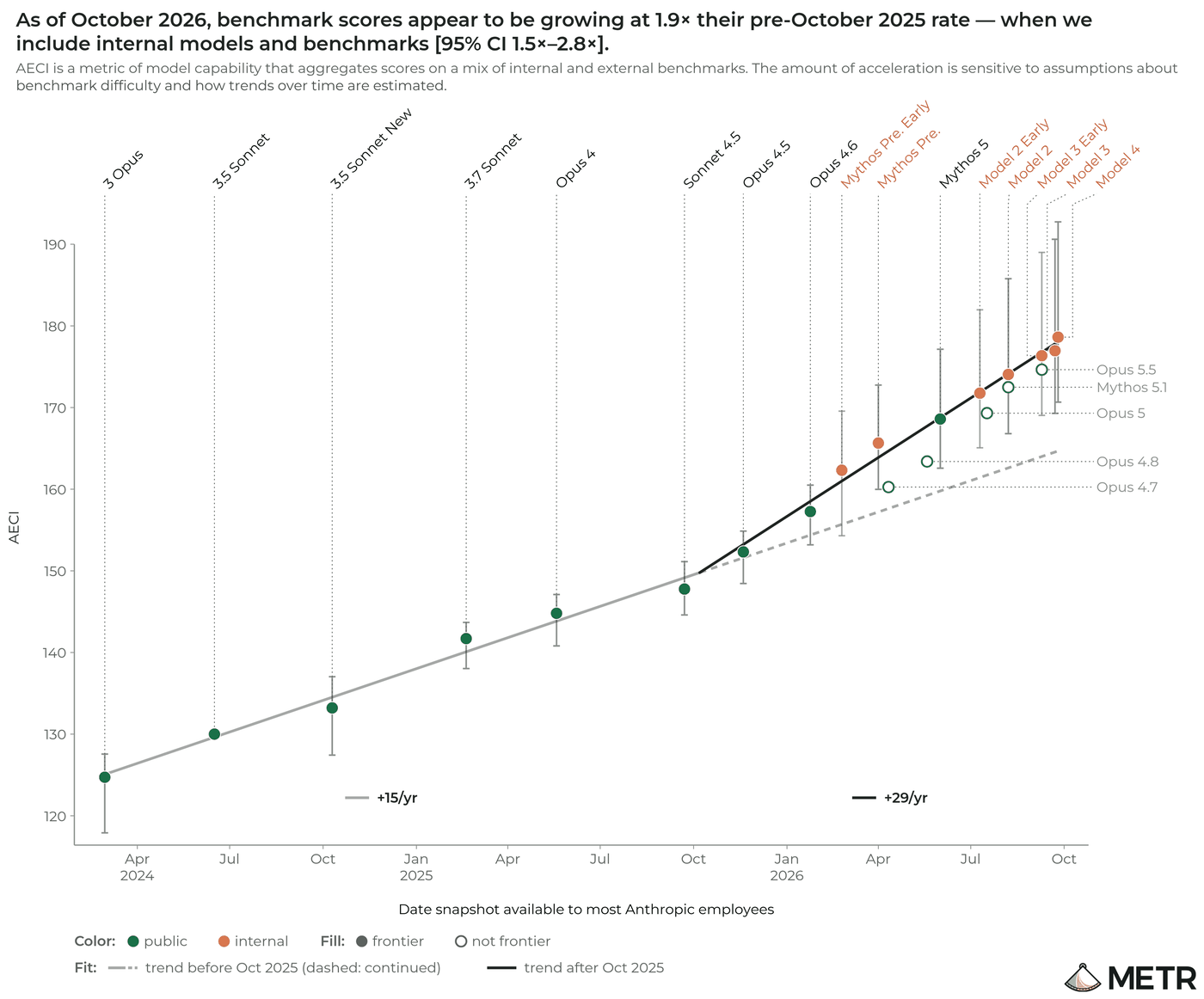
| AECI acceleration | 1.9x since Oct 2025 (95% CI 1.5–2.8x) |
| Share due to AI | ≈80% (METR's guess) |
| Full report | ~100 pages, not published |
What is it?
METR's report on AI R&D acceleration at Anthropic is a high-access, independent assessment run from August 12 to October 29, 2026. METR concludes Anthropic is likely improving capabilities on well-specified tasks at around twice its March 2024 to October 2025 rate, and would not be surprised by anything from 1.3x to 3x.
How does it work?
METR got internal benchmark scores and AECI, Anthropic's version of the Epoch Capabilities Index, for internal models, plus training-compute data, headcount, inference spend, surveys and about 15 staff interviews. Trend fits with a breakpoint at October 7, 2025 give a 1.9x acceleration (95% CI 1.5–2.8x). METR had no query access to unreleased models.
Why does it matter?
Anthropic's Responsible Scaling Policy treats AI R&D acceleration as a key risk indicator, and this is the first outside estimate of it at a frontier lab. METR guesses about 80% of the speed-up comes from AI, not extra training compute. Anthropic redacted a majority of the evidence METR found most informative, so readers must rely on METR's judgment.
Who is it for?
AI safety researchers, policy makers and anyone tracking frontier-lab risk
Frequently asked questions
- What did Anthropic redact from the METR report?
- Anthropic had unilateral redaction rights over METR's report and removed a majority of the evidence METR found most informative. Redacted parts include per-stage acceleration and attribution estimates, the compute, data and algorithm breakdown, algorithmic progress estimates, bottleneck analyses, forecasts for future models and specific benchmark names. Anthropic says the goal was to remove confidential information that could help other AI developers.
- Is the acceleration at Anthropic caused by more training compute?
- METR says it is confident the acceleration at Anthropic was not caused by faster scaling of training compute. Its best guess is that about 80% of the October 2026 speed-up comes from AI use inside Anthropic, with substantial uncertainty. METR adds that the late-2025 acceleration was likely influenced by non-AI factors as well.
- How confident is METR in the 2x estimate?
- METR calls 2x its likely estimate but says it would not be surprised by a rate anywhere from 1.3x to 3x the historical pace. Robustness checks on the AECI fit range from 1.1x to 2.9x. METR lists benchmark saturation, limited access, heavy reliance on two Anthropic staff for data, and Claude's role in the analysis as reasons for caution.
- Did METR test Anthropic's unreleased models directly?
- No. METR did not have query access to Anthropic's unreleased models and worked on Anthropic devices. It relied on internal benchmark and AECI scores, compute and headcount metrics, inference spend, internal surveys and about 15 staff interviews. METR says staff-level access would allow a significantly deeper assessment.
Try it
https://metr.org/blog/2026-11-05-anthropic-ai-rd-acceleration-assessment/