Google · 2026-11-09 · major
TPU 8tx and TPU 8i Max — Google adds a confidential TPU and a dual-chip TPU
Google adds two eighth-generation TPU systems. TPU 8tx runs confidential inference on TPU 8t silicon with AMD EPYC hosts. TPU 8i Max puts two TPU 8i chips in one package for twice the compute, SRAM and HBM bandwidth.
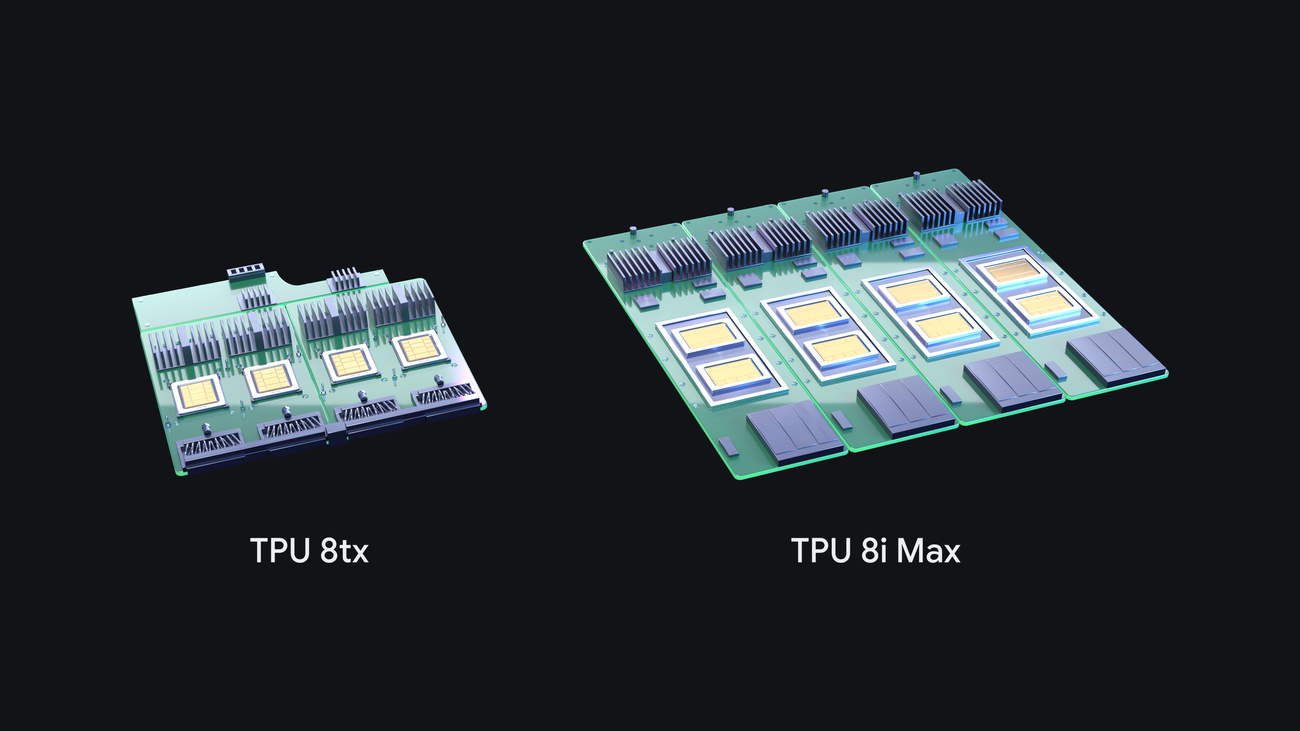
Google's TPU line gets a secure inference system for sensitive data and a denser chip for very long context.
Quick facts
| Maker | |
|---|---|
| TPU 8tx | Confidential inference, TPU 8t silicon + AMD EPYC hosts |
| TPU 8i Max | Two TPU 8i chips in one package |
| 8i Max vs 8i | 2x compute, 2x SRAM, 2x HBM bandwidth |
| 8tx latency | Up to 2x lower than TPU 8t |
| Availability | No date or price announced |
What is it?
TPU 8tx and TPU 8i Max are two new systems in Google's eighth TPU generation, which launched in April with TPU 8t for training and TPU 8i for inference. TPU 8tx is built for secure, confidential inference and small-scale training. TPU 8i Max combines two TPU 8i chips on one package for workloads with massive context windows.
How does it work?
The confidential TPU 8tx uses the same silicon as TPU 8t, paired with 5th Gen AMD EPYC CPU hosts, and protects data and model weights with hardware-level isolation while they are in use. Its Boardfly network gives up to 2x lower latency than TPU 8t, with a near-zero performance penalty. The dual-chip 8i Max fits twice the silicon in the same rack footprint as TPU 8i.
Why does it matter?
Regulated companies and governments can run frontier or proprietary models and agents next to their most sensitive data without leaving the hardware enclave. Alongside the chips, Google shipped software for agent workloads: an open-source TPU agent suite in preview that plugs into coding tools like Claude Code, Agent Compute Engine, which suspends and resumes idle agent sessions, and TPU Sync, an open-source library for moving KV caches and weights.
Who is it for?
AI infrastructure teams and Google Cloud customers
Frequently asked questions
- When can I rent TPU 8tx or TPU 8i Max on Google Cloud?
- Google has not given a release date or pricing for TPU 8tx or TPU 8i Max. The November 9 announcement describes the systems and their target users, and points readers to the Google Cloud website for more information. The earlier TPU 8t and TPU 8i systems were introduced at Google Cloud Next in April 2026.
- How is TPU 8tx different from TPU 8t?
- TPU 8tx uses the same silicon as Google's TPU 8t training chip but pairs it with 5th Gen AMD EPYC CPU hosts and hardware-level isolation, so data and model weights stay protected while in use. Google says its Boardfly network gives TPU 8tx up to 2x lower latency than TPU 8t, with a near-zero performance penalty for the added security.
- What is TPU Sync and is it open source?
- TPU Sync is an open-source C++ library Google released alongside TPU 8tx and TPU 8i Max. It moves KV caches and model weights between TPU memory, host memory, storage and the network. Google says it cuts KV transfer latency and time to first token by more than 90%, and it ships Python wheels for PyTorch and JAX.
- Can I use Google TPUs with coding agents like Claude Code?
- Google's new open-source TPU agent suite, now in preview, plugs directly into coding tools like Claude Code, Cursor and Google Antigravity. It is part of the TPU software stack announced with TPU 8tx and TPU 8i Max, which also includes the open-source TorchTPU backend for running PyTorch and Hugging Face models natively on TPUs.